Stylized Forest Assets
From simple plant shapes to a cohesive game environment
This project explores a stylized tropical vegetation collection through concept development, modeling, material design, and environment composition.
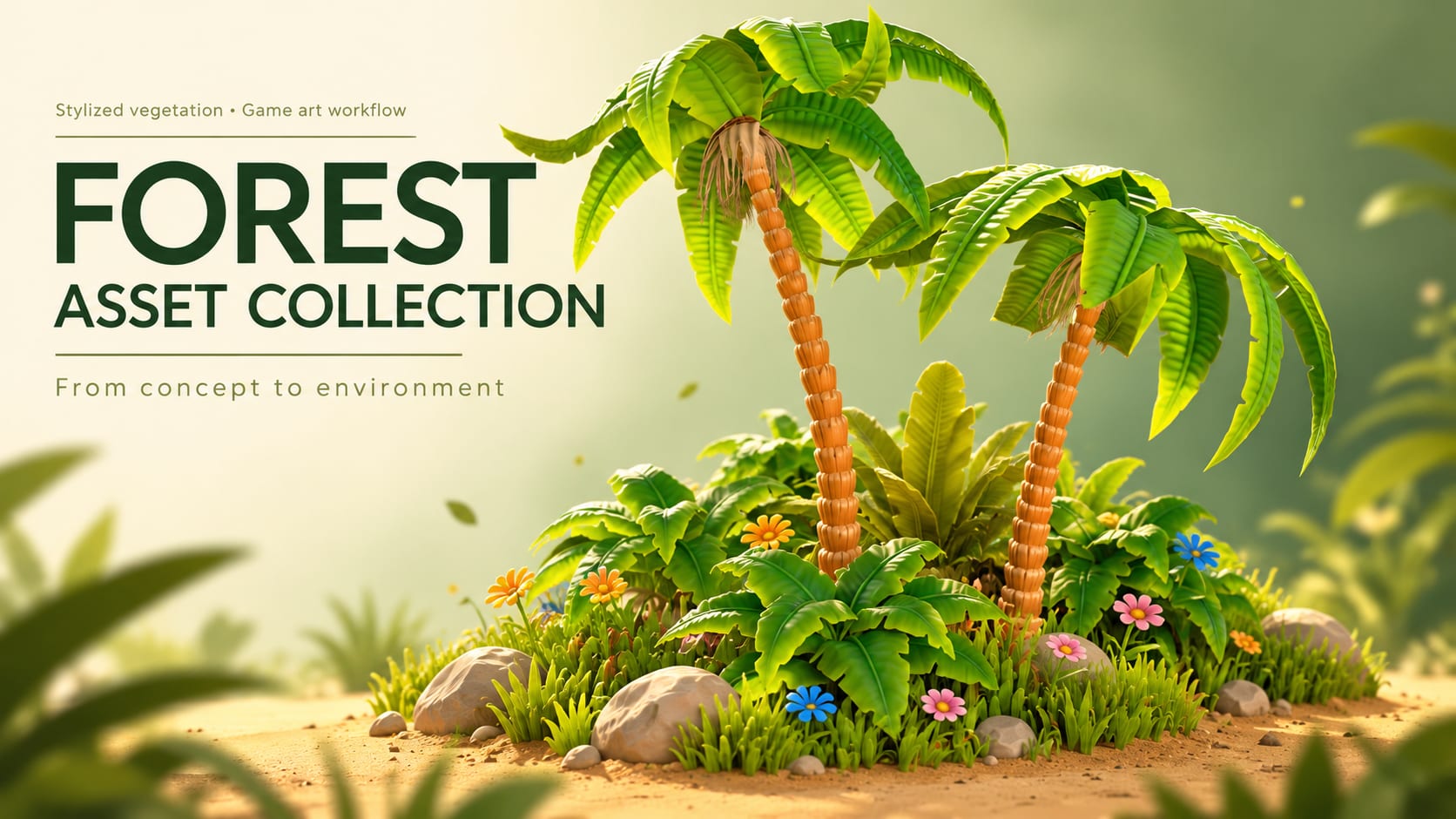
A forest feels convincing when its plants work together. Tree silhouettes establish the canopy, broadleaf plants fill the middle layer, and grass and flowers connect everything to the ground.
This project explores a stylized tropical vegetation collection through concept development, modeling, material design, and environment composition. The aim is to show how a small asset collection can support a much larger forest scene.
The Challenge: Create Variety Without Building Every Plant From Scratch
Repeated assets can quickly become noticeable. Similar tree spacing, identical plant rotations, and evenly scattered flowers can make a forest feel artificial.
The solution begins with a collection of complementary shapes: tall curved palms, upright foliage, low spreading plants, grass clumps, and small flower accents. Each asset serves a different purpose, allowing variety to come from arrangement as well as individual design.
01 — Explore Shapes Before Adding Detail
Start with rough black-and-white sketches. Explore different trunk bends, canopy widths, leaf directions, and plant heights before choosing a final design.
At this stage, focus on the outline. A palm should remain recognizable without color or surface detail. Ground plants should have distinct silhouettes so they do not blend into one repeated shape.
Practical lesson: View sketches at thumbnail size. If the shapes become difficult to distinguish, simplify their outlines or adjust their proportions.
02 — Build a Consistent Color Palette
Once the silhouettes work, introduce flat colors before painting detailed shading.
The collection combines yellow-green palm leaves, deeper green ground foliage, warm orange-brown trunks, and small blue, pink, and orange flowers. These color differences help separate vegetation layers while keeping the collection visually connected.
Problem to solve: Too many bright colors compete for attention.
Approach: Keep foliage dominant and use flowers as occasional accents. Leave quieter areas between colorful clusters so focal points remain clear.
03 — Test Proportions With a 3D Blockout
Build the first models using simple forms: curved trunks, broad leaf shapes, basic petals, and grouped grass blades.
Arrange the blockout assets together early. A plant that looks balanced by itself may feel oversized beside another asset or block an important view when repeated.
Practical lesson: Review the collection from the intended game camera distance. Adjust canopy width, plant height, and ground coverage before investing in detail.
04 — Refine the Shapes That Define the Style
Develop the leaf arches, tapered tips, uneven edges, and segmented trunks. Introduce controlled asymmetry so plants feel organic while preserving clear silhouettes.
The broadleaf plants need a different rhythm from the palms. Their shorter, wider leaves create dense lower shapes that contrast with the tall trunks and hanging canopy.
Optimization principle: Add geometry where it improves the visible outline or supports a necessary bend. Surface detail alone does not always require additional polygons.
05 — Make Detail Support Readability
Leaf ribs, central veins, bark grooves, and flower centers give the assets their surface character. Keep these details broad enough to remain useful at the viewing distance.
Problem to solve: Fine details can disappear when the camera moves away, while still increasing production and rendering cost.
Approach: Prioritize larger forms first. Check close-up details from the gameplay view, then decide which belong in geometry and which can be represented through textures.
06 — Plan UVs Around Reusable Parts
A practical UV workflow separates leaves, trunk sections, petals, and grass into manageable islands. Check distortion with a checker pattern before texturing, and leave sufficient padding between islands.
Similar parts may share texture space when they do not need unique markings. More visible areas can receive additional texture space where it improves the result.
Practical lesson: Match texture detail to what the player can see. Small background elements rarely need the same texture allocation as a prominent foreground asset.
07 — Use Materials to Reinforce Form
Build the base color around clear leaf gradients, readable veins, and controlled variation. Use roughness to separate softer foliage surfaces from drier bark.
Review materials under neutral lighting as well as the final presentation lighting. This helps reveal whether the colors and surface response work beyond a single attractive render.
For foliage that uses transparency, keep empty space around the visible leaf shape limited. Overlapping transparent surfaces can become costly in dense vegetation.
08 — Assemble the Forest in Layers
Place the largest forms first. Use palms to establish canopy coverage and frame the scene, then add broadleaf plants to build the understory.
Grass connects plant clusters to the terrain. Flowers provide selective accents near focal points or along the path. Vary rotation, spacing, and scale within believable limits.
Problem to solve: Random scattering can produce visual noise and obscure the route through the scene.
Approach: Build intentional clusters and preserve open areas. A winding path gives the composition direction and allows the surrounding vegetation to feel dense without filling every space.
09 — Validate Before Calling the Assets Game Ready
A finished render demonstrates visual quality. Game readiness also requires checking the source assets inside the target engine.
Review material count, texture memory, transparency overlap, distant silhouettes, and performance in a densely populated scene. Test level-of-detail transitions and foliage culling at the distances the game actually uses.
Make optimization decisions from those results. Repeated meshes, shared materials, and reduced distant detail can help, but their impact depends on the scene and engine setup.
The Result
The presentation shows how a compact vegetation collection can be developed into a layered tropical forest concept. Clear silhouettes, a coordinated palette, and deliberate placement create visual variety while keeping the assets connected.
The central lesson is to design each plant as part of an environment. Strong individual assets matter, but their scale, spacing, repetition, and relationships determine how well the forest works.
Process images are illustrative reconstructions based on the supplied renders. UV layouts, texture-map studies, and environment scenes do not document verified source files or engine performance.